

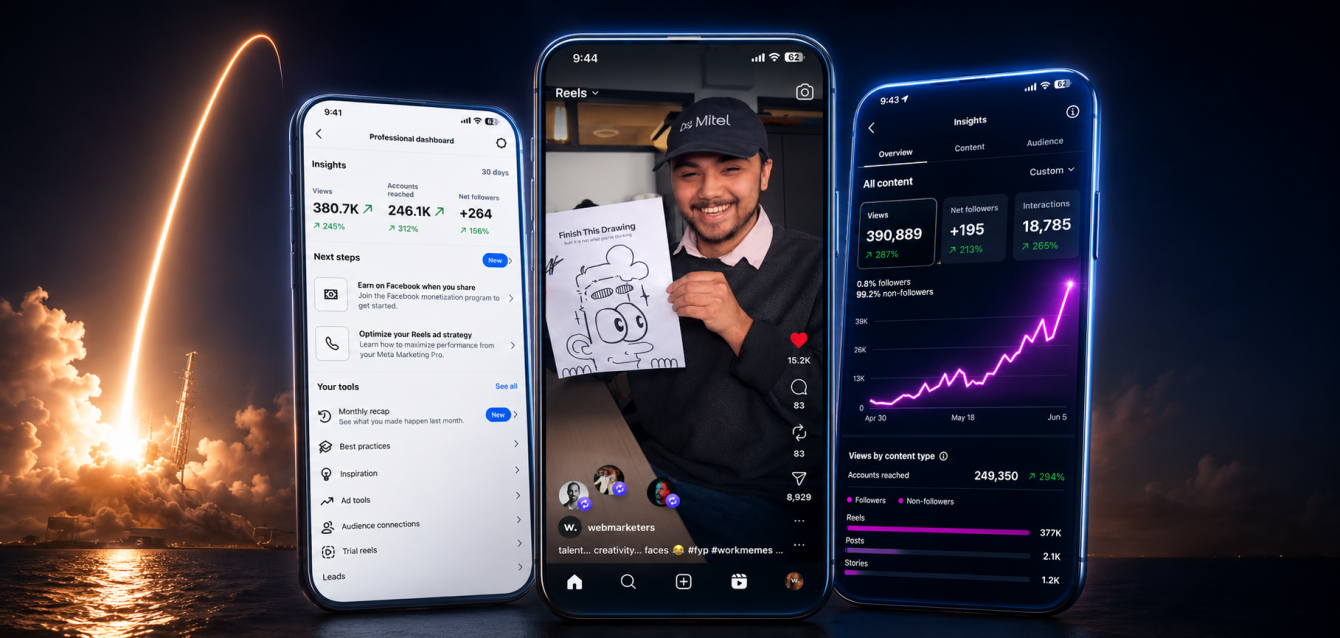
Most businesses post on social media the same way they used to hand out flyers at a trade show. Put it out there, hope someone picks it up, move on to the next one.
Then they wonder why nothing works.
Here’s the truth from someone who does this every day, has studied what the algorithm actually rewards, and just watched one of our own posts break through in an epic way: your content isn’t failing because it’s not polished enough. It’s failing because it never hit escape velocity. And no, that’s not a buzzword. It’s literally how every major social platform decides whether your post lives or dies. Viral posts live a long time and continue to be shared the whole time. Just look for yourself at the created date next time you’re doom scrolling in your feed.
Let’s break down how that works, why AI content isn’t the villain everyone says it is, and what CPG brands can teach the rest of us about earning real attention.
The Algorithm Isn’t a Mystery. It’s a Gauntlet.
Every platform, whether it’s Instagram, TikTok, LinkedIn, or YouTube Shorts, runs on the same core mechanic. When you publish a post, the algorithm doesn’t blast it to all your followers and let the market decide. It does something far more calculated.
It shows your content to a small test audience. Think of it as a sample size of roughly 200 to 500 people, a mix of followers and non-followers who match certain interest signals. Then it watches. Closely.
Did people stop scrolling? Did they watch to the end? Did they comment, save, or share? If your post outperforms the engagement norms for that initial sample, it graduates. The algorithm pushes it to a bigger pool, say 5,000 people. Same test. Same metrics. Higher standards. Outperform again and you get pushed to 50,000. Then 500,000.
This is escape velocity. Each tier is a gate, and the only key is engagement that exceeds the benchmark for that audience size.
According to Socialinsider’s 2026 benchmarks, the average Instagram engagement rate sits at just 0.48%. RivalIQ’s cross-industry median is even lower at 0.36%. That means most content doesn’t just underperform, it flatlines at the first gate. It never gets the chance to reach a broader audience because it didn’t earn the right to.
This is important context because it reframes the entire conversation. It’s not about posting more. It’s not about having a bigger budget. It’s about making content that a small group of real humans genuinely care about enough to interact with. If 500 people don’t engage, 5,000 never see it.
AI Didn’t Kill Your Content. Lazy AI Did.
There’s a loud conversation happening right now about whether AI-generated content is “ruining” social media. We’d argue that’s the wrong question entirely.
At WebMarketers, we just launched Kinetic Intelligence, our technology division focused on helping SMBs adopt and implement AI into their businesses. We’re not anti-AI. We’d be hypocrites if we were. What we are is anti-lazy.
You know the content we’re talking about. The posts loaded with emojis in a perfect pattern. The captions with three em dashes in two sentences. The carousels that feel like they were assembled by a prompt and posted without a single human editing pass. You see it, you recognize it immediately, and you scroll past it. Everyone does.
A 2025 Stackla study found that 88% of consumers say authenticity is a key factor in deciding which brands they support, and 56% of consumers feel that brands don’t produce enough authentic content. People have developed antibodies to generic. They can spot a formulaic AI post faster than they can read the caption, and their thumb is already moving before they finish the first line.
But here’s the nuance: AI as a tool to research, draft, ideate, or edit is incredibly powerful. The problem isn’t AI in the process. The problem is AI as the entire process. When a human uses AI to get to a better version of their own idea faster, the output still has voice, personality, and point of view. When AI is the voice, personality, and point of view, you get wallpaper. And wallpaper doesn’t pass the first gate.
The Hook, Ladder, Climax Formula
So if engagement at the first sample is everything, how do you actually earn it?
The most consistently effective structure for short-form video content, which is the dominant format across every platform right now, follows what’s known as the Hook, Ladder, Climax formula.
The Hook (0-3 seconds): You have less than three seconds to stop someone mid-scroll. This isn’t an intro. It’s an interruption. The best hooks create an open loop, something the viewer can’t resolve without watching more. “This is the biggest mistake I see businesses make on social” works. “Hey everyone, welcome back to our page” does not. Data from Meta’s own internal research suggests that 65% of people who watch the first three seconds of a video will watch for at least 10 more seconds. Win the hook, win the first battle.
The Ladder (3-30+ seconds): This is where you build tension or deliver escalating value. Each piece of information should raise the stakes slightly. You’re not dumping everything at once. You’re climbing a ladder where every rung makes the viewer think “okay, what’s next?” This is what drives watch-through rate, which is one of the heaviest signals the algorithm uses to determine whether your content deserves a bigger audience.
The Climax (final moments): The payoff. Ideally, it’s unexpected. The best-performing content doesn’t just deliver on the promise of the hook. It over-delivers or subverts expectations entirely. That emotional hit at the end, the laugh, the shock, the insight they didn’t see coming, is what triggers the share. And every share is exponentially more eyeballs, because it carries an implicit endorsement from a friend.
We recently put this exact formula to work on our own Instagram, and the results spoke for themselves. A single Reel broke through in a way that our typical content doesn’t, not because we threw money at it, but because it was structured to earn attention at every stage. Hook to stop the scroll. Ladder to keep them watching. Climax to make them share. We walk this walk.
Is this a guarantee your next post goes viral? Absolutely not. But it’s the formula that gives you the highest odds of passing each gate and reaching the next audience tier. You have to give yourself the chance.
What Service Businesses Can Learn from CPG
Consumer packaged goods (CPG) brands have been ahead of the curve here, and it’s worth studying why.
Brands like Liquid Death, Duolingo, and Scrub Daddy don’t post like “brands.” They post like creators. Their content is raw, personality-driven, trend-aware, and often intentionally imperfect. Liquid Death’s social content looks like it was made by an unhinged intern with a camera phone, and that’s precisely why it works. Their TikTok alone has generated hundreds of millions of organic views without leaning on traditional ad creative.
These CPG brands understood something early: people don’t follow brands on social media to be marketed to. They follow for entertainment, relatability, or utility. And the content that delivers those things in an authentic, human way is the content that passes through every algorithmic gate.
For service-based businesses like agencies, consultancies, SaaS companies, or professional services firms, this can feel uncomfortable. You don’t have a physical product to put in someone’s hands. You can’t do a satisfying unboxing. But the principles transfer directly:
- Lead with the human, not the logo. People engage with faces and personalities, not brand guidelines.
- Tap into trends, but add your own angle. Using a trending audio or format gets you discoverability. Adding your industry-specific twist gives you shareability.
- Stop polishing everything to death. Some of the highest-performing content we’ve seen, for our clients and ourselves, was shot on a phone with natural lighting and zero post-production. The rawness signals authenticity, and authenticity is what earns trust and engagement in 2026.
- Prioritize shareability over impressions. One share carries more algorithmic weight than dozens of passive views because it signals that someone found your content valuable enough to attach their own reputation to it.
The Metric That Actually Matters
If you take one thing from this, let it be this: stop obsessing over follower count and start obsessing over engagement rate relative to reach.
Sprout Social’s 2026 data confirms that niche accounts with 1,000 to 10,000 followers regularly outperform massive accounts on engagement rate, often hitting 4-6% while accounts with 100K+ followers hover below 1%. The algorithm doesn’t care how many followers you have. It cares whether the people who see your content actually do something with it.
That’s the game. Create content that earns a reaction from a small group, and the algorithm does the rest. Fail that first test, and it doesn’t matter if you have a million followers. Your post dies in the first 500.
Give Yourself the Chance
There’s no cheat code for virality. Anyone who tells you otherwise is selling something. But there is a formula that consistently increases your odds:
Structure your content with a hook, ladder, and climax. Make it authentically human, even if AI helped you get there. Study what CPG brands do well and adapt it for your industry. And respect the way the algorithm actually works: earn your audience in tiers, starting with the first 500.
We build these strategies for our clients every day, and when we post for ourselves, we follow the same playbook. Not every post breaks through. But the ones that do, they don’t happen by accident.
If your social content has been feeling like it’s going nowhere, it might not be a content problem. It might be an escape velocity problem.
Ready to build a social strategy that actually earns attention? Let’s talk.